Touch supervision, every time
The AAP recommends staying within arm's reach of young children in or near any water, including bathtubs and small pools. Assign one adult as the dedicated 'water watcher' with no phones or distractions.


Parenting Tips
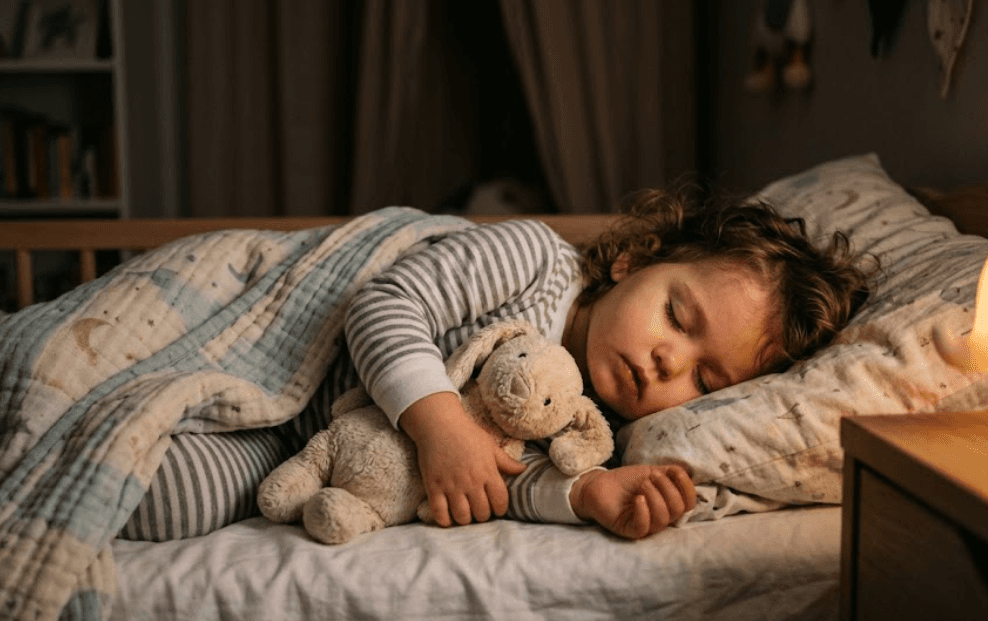
If you have a toddler or preschooler who won't go to sleep, wakes repeatedly at night, or starts the day at 5am like clockwork — you're not alone, and you're probably exhausted.
Sleep is one of the most common challenges parents of young children face. It's also one of the most important things to get right. Not because a bad night here and there is a crisis — it isn't — but because chronic sleep deprivation in early childhood has real, measurable effects on development, behavior, learning, and emotional regulation.
The good news: sleep habits are habits. They can be built, shaped, and improved — at almost any age — with consistency and the right approach.
During sleep, the brain does its most important work. For young children, this is especially true.
Memory consolidation — everything your child learned during the day — new words, new skills, new social experiences — gets processed and stored during sleep. A well-rested child literally learns more from the same day than a sleep-deprived one.
Growth hormone release — the majority of growth hormone is released during deep sleep. Children who consistently sleep well grow more effectively than children with fragmented or insufficient sleep.
Emotional regulation — the prefrontal cortex, which manages impulse control and emotional regulation, is acutely sensitive to sleep deprivation. A tired toddler isn't being difficult — their brain is genuinely less able to regulate. More sleep means fewer meltdowns, not because the child is better behaved, but because their brain is better equipped.
Immune function — sleep is when the immune system does its primary maintenance work. Children who sleep well get sick less often and recover faster.
Daytime behavior and learning — children who arrive at daycare or preschool well-rested participate more fully, manage transitions more smoothly, and show stronger attention and cognitive engagement throughout the day. Our teachers see this every single day.
Sleep needs vary by age — and most children need more than parents assume. These are the ranges recommended by the American Academy of Sleep Medicine, endorsed by the American Academy of Pediatrics.
If you have a toddler or preschooler who won't go to sleep, wakes repeatedly at night, or starts the day at 5am like clockwork — you're not alone, and you're probably exhausted.
Sleep is one of the most common challenges parents of young children face. It's also one of the most important things to get right. Not because a bad night here and there is a crisis — it isn't — but because chronic sleep deprivation in early childhood has real, measurable effects on development, behavior, learning, and emotional regulation.
The good news: sleep habits are habits. They can be built, shaped, and improved — at almost any age — with consistency and the right approach.
During sleep, the brain does its most important work. For young children, this is especially true.
Memory consolidation — everything your child learned during the day — new words, new skills, new social experiences — gets processed and stored during sleep. A well-rested child literally learns more from the same day than a sleep-deprived one.
Growth hormone release — the majority of growth hormone is released during deep sleep. Children who consistently sleep well grow more effectively than children with fragmented or insufficient sleep.
Emotional regulation — the prefrontal cortex, which manages impulse control and emotional regulation, is acutely sensitive to sleep deprivation. A tired toddler isn't being difficult — their brain is genuinely less able to regulate. More sleep means fewer meltdowns, not because the child is better behaved, but because their brain is better equipped.
Immune function — sleep is when the immune system does its primary maintenance work. Children who sleep well get sick less often and recover faster.
Daytime behavior and learning — children who arrive at daycare or preschool well-rested participate more fully, manage transitions more smoothly, and show stronger attention and cognitive engagement throughout the day. Our teachers see this every single day.
Sleep needs vary by age — and most children need more than parents assume. These are the ranges recommended by the American Academy of Sleep Medicine, endorsed by the American Academy of Pediatrics.
One of the most common mistakes parents make is confusing when a child gets into bed with when they actually fall asleep. If your child is in bed at 8pm but doesn't fall asleep until 9:30pm — their actual sleep time is 9:30pm, not 8pm.
Watch for signs of true tiredness rather than following a clock: eye rubbing, yawning, decreased activity, becoming quieter or more emotional. These are your window. Putting a child to bed before they show these signs often results in prolonged bedtime battles. Waiting too long past the window results in overtiredness — which paradoxically makes it harder to fall asleep, not easier.
This sweet spot — catching the window of natural tiredness — is one of the most powerful tools in building a smooth bedtime routine.
These are evidence-based strategies drawn from pediatric sleep research. None require special equipment or expensive programs — just consistency and a willingness to hold the line.
One of the most common mistakes parents make is confusing when a child gets into bed with when they actually fall asleep. If your child is in bed at 8pm but doesn't fall asleep until 9:30pm — their actual sleep time is 9:30pm, not 8pm.
Watch for signs of true tiredness rather than following a clock: eye rubbing, yawning, decreased activity, becoming quieter or more emotional. These are your window. Putting a child to bed before they show these signs often results in prolonged bedtime battles. Waiting too long past the window results in overtiredness — which paradoxically makes it harder to fall asleep, not easier.
This sweet spot — catching the window of natural tiredness — is one of the most powerful tools in building a smooth bedtime routine.
These are evidence-based strategies drawn from pediatric sleep research. None require special equipment or expensive programs — just consistency and a willingness to hold the line.
One of the most common mistakes parents make is confusing when a child gets into bed with when they actually fall asleep. If your child is in bed at 8pm but doesn't fall asleep until 9:30pm — their actual sleep time is 9:30pm, not 8pm.
Watch for signs of true tiredness rather than following a clock: eye rubbing, yawning, decreased activity, becoming quieter or more emotional. These are your window. Putting a child to bed before they show these signs often results in prolonged bedtime battles. Waiting too long past the window results in overtiredness — which paradoxically makes it harder to fall asleep, not easier.
This sweet spot — catching the window of natural tiredness — is one of the most powerful tools in building a smooth bedtime routine.
These are evidence-based strategies drawn from pediatric sleep research. None require special equipment or expensive programs — just consistency and a willingness to hold the line.
Each layer covers a different kind of risk, and together they create a much stronger safety net than any one step alone. A locked gate doesn't remove the need for supervision, and swim lessons don't remove the need for a life jacket on a boat.
The AAP recommends staying within arm's reach of young children in or near any water, including bathtubs and small pools. Assign one adult as the dedicated 'water watcher' with no phones or distractions.
Four-sided pool fencing with a self-latching gate can prevent more than half of all swimming pool drownings among young children by removing unsupervised access during non-swim times.
Formal swim lessons can begin after a child's first birthday. Skills alone don't prevent drowning, but they add an important layer alongside supervision and barriers.
Coast Guard-approved life jackets are far more reliable than inflatable arm floaties or toys, especially around boats, lakes, and open water where conditions change quickly.
Keeping a phone poolside and having at least one caregiver trained in CPR can make a critical difference in the rare moments when the other layers aren't enough.
Infants
4 – 12 months12 – 16 hrs
including naps
Infants sleep in multiple short stretches. Consolidated nighttime sleep typically develops between 4 and 6 months.
Toddlers
1 – 2 years11 – 14 hrs
including naps
Most toddlers still need one nap per day. Total sleep across night and nap should reach 11–14 hours.
Preschoolers
3 – 5 years10 – 13 hrs
including naps if taken
Napping becomes optional around age 3–4. Children who drop the nap typically need an earlier bedtime to compensate.
School Age
6 – 12 years9 – 12 hrs
nighttime only
School-age children rarely nap. Consistent bedtimes in the 8–9pm range support the full sleep hours needed for learning and growth.
* Recommendations from the American Academy of Sleep Medicine, endorsed by the American Academy of Pediatrics.
Each layer covers a different kind of risk, and together they create a much stronger safety net than any one step alone. A locked gate doesn't remove the need for supervision, and swim lessons don't remove the need for a life jacket on a boat.
The AAP recommends staying within arm's reach of young children in or near any water, including bathtubs and small pools. Assign one adult as the dedicated 'water watcher' with no phones or distractions.
Four-sided pool fencing with a self-latching gate can prevent more than half of all swimming pool drownings among young children by removing unsupervised access during non-swim times.
Formal swim lessons can begin after a child's first birthday. Skills alone don't prevent drowning, but they add an important layer alongside supervision and barriers.
Coast Guard-approved life jackets are far more reliable than inflatable arm floaties or toys, especially around boats, lakes, and open water where conditions change quickly.
Keeping a phone poolside and having at least one caregiver trained in CPR can make a critical difference in the rare moments when the other layers aren't enough.
The same sequence every night — bath, pajamas, brush teeth, book, lights out — signals the brain that sleep is coming. Predictability is the single most powerful sleep tool available to parents. It works at 18 months and it works at 5 years.
The circadian rhythm runs on a 24-hour clock. Shifting bedtime by two hours on weekends creates the equivalent of weekly jet lag. Consistency within 30 minutes every day — including Saturday and Sunday — is what anchors sleep.
Even small amounts of light suppress melatonin production in young children. Blackout curtains are one of the highest-return investments in child sleep. A room that is truly dark at bedtime and at 5am makes a measurable difference.
The ideal sleep environment for young children is slightly cool — between 65 and 70°F. In Tampa's climate, air conditioning is essential. A child who is too warm will wake more frequently and sleep less deeply.
Blue light from screens suppresses melatonin and stimulates the brain — the opposite of what bedtime requires. The hour before bed should be calm and screen-free: books, quiet play, bath, conversation.
Children who fall asleep in a parent's arms and wake at 2am in their crib experience a mismatch — they need to recreate the conditions they fell asleep in to get back to sleep. A child who falls asleep independently in their own sleep space will self-soothe when they naturally rouse between sleep cycles.
When a child gets out of bed or calls out, return them calmly, warmly, and with minimal stimulation — every time. One phrase, one hug, back to bed. Inconsistency is what prolongs bedtime problems; consistency is what resolves them.
Talk to your child's daycare teacher about nap timing. A nap that ends at 4:30pm makes a 7:30pm bedtime nearly impossible. Knowing when your child naps — and how long — lets you adjust the evening schedule to set up a smoother night.
If you have a toddler or preschooler who won't go to sleep, wakes repeatedly at night, or starts the day at 5am like clockwork — you're not alone, and you're probably exhausted.
Sleep is one of the most common challenges parents of young children face. It's also one of the most important things to get right. Not because a bad night here and there is a crisis — it isn't — but because chronic sleep deprivation in early childhood has real, measurable effects on development, behavior, learning, and emotional regulation.
The good news: sleep habits are habits. They can be built, shaped, and improved — at almost any age — with consistency and the right approach.
During sleep, the brain does its most important work. For young children, this is especially true.
Memory consolidation — everything your child learned during the day — new words, new skills, new social experiences — gets processed and stored during sleep. A well-rested child literally learns more from the same day than a sleep-deprived one.
Growth hormone release — the majority of growth hormone is released during deep sleep. Children who consistently sleep well grow more effectively than children with fragmented or insufficient sleep.
Emotional regulation — the prefrontal cortex, which manages impulse control and emotional regulation, is acutely sensitive to sleep deprivation. A tired toddler isn't being difficult — their brain is genuinely less able to regulate. More sleep means fewer meltdowns, not because the child is better behaved, but because their brain is better equipped.
Immune function — sleep is when the immune system does its primary maintenance work. Children who sleep well get sick less often and recover faster.
Daytime behavior and learning — children who arrive at daycare or preschool well-rested participate more fully, manage transitions more smoothly, and show stronger attention and cognitive engagement throughout the day. Our teachers see this every single day.
Sleep needs vary by age — and most children need more than parents assume. These are the ranges recommended by the American Academy of Sleep Medicine, endorsed by the American Academy of Pediatrics.
What happens at daycare during the day directly affects how your child sleeps at night. At Little Einsteins Academy of Tampa, we treat nap time and daily routines as an important part of the partnership between home and school.
What every LEAO family can count on
Better days start with better nights.
Come visit LEAO and see how our daily routines support your child's sleep — and your whole family's wellbeing.
Sleep recommendations referenced from the American Academy of Sleep Medicine and American Academy of Pediatrics. For concerns about your child's sleep, consult your pediatrician. Little Einsteins Academy of Tampa is fully licensed by the Florida Department of Children and Families.
Categorías
Publicación reciente