Touch supervision, every time
The AAP recommends staying within arm's reach of young children in or near any water, including bathtubs and small pools. Assign one adult as the dedicated 'water watcher' with no phones or distractions.


Early Learning
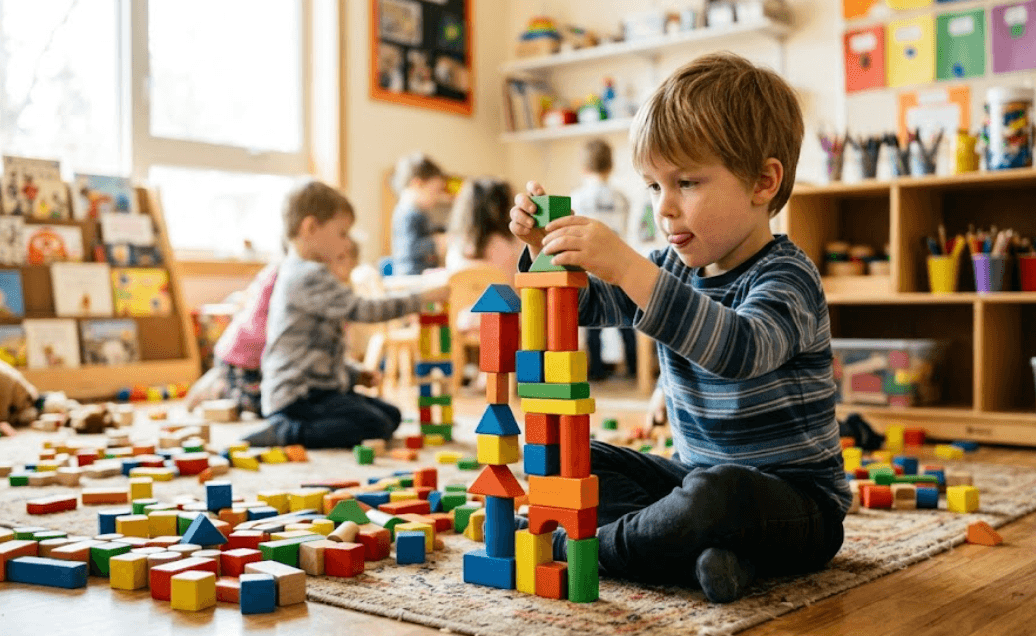
"They're just playing."
It's a phrase parents sometimes think — and occasionally say — when they walk into a preschool classroom and see children at a water table, building with blocks, or acting out a scene in a pretend kitchen. If learning is happening, where is it?
The answer is: everywhere. Every single thing happening in that classroom is learning — and the research on play-based early childhood education is among the most robust and consistent in developmental science.
Children don't learn best by sitting still and receiving instruction. They learn through movement, exploration, repetition, social negotiation, creative problem-solving, and the deeply motivated engagement that comes when they are genuinely interested in what they're doing. That's play. And play, done well and supported intentionally by skilled educators, is the most powerful learning tool available to young children.
The case for play-based learning isn't built on philosophy — it's built on decades of research from cognitive science, developmental psychology, and neuroscience.
Play activates more of the brain simultaneously than direct instruction. When a child is playing — especially in unstructured or dramatic play scenarios — multiple brain regions are engaged at once: the prefrontal cortex for planning and decision-making, the hippocampus for memory formation, the motor cortex for physical engagement, and social brain networks for peer interaction. Direct instruction, by contrast, tends to activate narrower pathways.
Children retain more from self-directed discovery. The "generation effect" — a well-documented cognitive phenomenon — shows that information we generate ourselves is remembered more reliably than information we're given. A child who figures out through play that a tall, narrow block tower falls more easily than a wide, short one has learned a physics concept more durably than a child who was told the same thing.
Play develops executive function — the cluster of cognitive skills that includes working memory, cognitive flexibility, and inhibitory control. These skills are among the strongest predictors of academic and life success, and they develop primarily through play — particularly rule-based games and dramatic play where children must hold rules in mind while managing their behavior.
Stress hormones drop during play. Cortisol levels — markers of stress — consistently decrease during free play. A child who arrives at daycare anxious or dysregulated can literally reset their nervous system through play. This matters for learning, because children learn most effectively when their stress response is calm.
Not all play is the same. Understanding the different types of play helps parents and educators appreciate the specific skills each one develops.
"They're just playing."
It's a phrase parents sometimes think — and occasionally say — when they walk into a preschool classroom and see children at a water table, building with blocks, or acting out a scene in a pretend kitchen. If learning is happening, where is it?
The answer is: everywhere. Every single thing happening in that classroom is learning — and the research on play-based early childhood education is among the most robust and consistent in developmental science.
Children don't learn best by sitting still and receiving instruction. They learn through movement, exploration, repetition, social negotiation, creative problem-solving, and the deeply motivated engagement that comes when they are genuinely interested in what they're doing. That's play. And play, done well and supported intentionally by skilled educators, is the most powerful learning tool available to young children.
The case for play-based learning isn't built on philosophy — it's built on decades of research from cognitive science, developmental psychology, and neuroscience.
Play activates more of the brain simultaneously than direct instruction. When a child is playing — especially in unstructured or dramatic play scenarios — multiple brain regions are engaged at once: the prefrontal cortex for planning and decision-making, the hippocampus for memory formation, the motor cortex for physical engagement, and social brain networks for peer interaction. Direct instruction, by contrast, tends to activate narrower pathways.
Children retain more from self-directed discovery. The "generation effect" — a well-documented cognitive phenomenon — shows that information we generate ourselves is remembered more reliably than information we're given. A child who figures out through play that a tall, narrow block tower falls more easily than a wide, short one has learned a physics concept more durably than a child who was told the same thing.
Play develops executive function — the cluster of cognitive skills that includes working memory, cognitive flexibility, and inhibitory control. These skills are among the strongest predictors of academic and life success, and they develop primarily through play — particularly rule-based games and dramatic play where children must hold rules in mind while managing their behavior.
Stress hormones drop during play. Cortisol levels — markers of stress — consistently decrease during free play. A child who arrives at daycare anxious or dysregulated can literally reset their nervous system through play. This matters for learning, because children learn most effectively when their stress response is calm.
Not all play is the same. Understanding the different types of play helps parents and educators appreciate the specific skills each one develops.
Play-based learning is not the absence of teaching — it's a different kind of teaching. In a high-quality play-based classroom, the environment itself is the curriculum: every material, every arrangement of space, every choice about what's available and how it's presented is intentional.
A skilled early childhood educator in a play-based setting:
Observes before intervening — watching what children are doing and thinking before jumping in, to understand where each child is and what they're working on.
Extends rather than redirects — when a child is engaged in an activity, the teacher deepens it with a question or a provocation rather than moving the child to something else.
Follows the child's lead — using the child's genuine interest as the entry point for learning, rather than imposing a predetermined topic.
Scaffolds challenge — making activities slightly harder than what the child can do independently, operating in what developmental psychologist Lev Vygotsky called the "zone of proximal development."
Documents learning — noticing and recording what skills children are developing through their play, connecting those observations to developmental frameworks and sharing them with families.
The outcomes of play-based learning aren't abstract. They show up in concrete, measurable skills that matter for school, work, and life.
Play-based learning is not the absence of teaching — it's a different kind of teaching. In a high-quality play-based classroom, the environment itself is the curriculum: every material, every arrangement of space, every choice about what's available and how it's presented is intentional.
A skilled early childhood educator in a play-based setting:
Observes before intervening — watching what children are doing and thinking before jumping in, to understand where each child is and what they're working on.
Extends rather than redirects — when a child is engaged in an activity, the teacher deepens it with a question or a provocation rather than moving the child to something else.
Follows the child's lead — using the child's genuine interest as the entry point for learning, rather than imposing a predetermined topic.
Scaffolds challenge — making activities slightly harder than what the child can do independently, operating in what developmental psychologist Lev Vygotsky called the "zone of proximal development."
Documents learning — noticing and recording what skills children are developing through their play, connecting those observations to developmental frameworks and sharing them with families.
The outcomes of play-based learning aren't abstract. They show up in concrete, measurable skills that matter for school, work, and life.
Play-based learning is not the absence of teaching — it's a different kind of teaching. In a high-quality play-based classroom, the environment itself is the curriculum: every material, every arrangement of space, every choice about what's available and how it's presented is intentional.
A skilled early childhood educator in a play-based setting:
Observes before intervening — watching what children are doing and thinking before jumping in, to understand where each child is and what they're working on.
Extends rather than redirects — when a child is engaged in an activity, the teacher deepens it with a question or a provocation rather than moving the child to something else.
Follows the child's lead — using the child's genuine interest as the entry point for learning, rather than imposing a predetermined topic.
Scaffolds challenge — making activities slightly harder than what the child can do independently, operating in what developmental psychologist Lev Vygotsky called the "zone of proximal development."
Documents learning — noticing and recording what skills children are developing through their play, connecting those observations to developmental frameworks and sharing them with families.
The outcomes of play-based learning aren't abstract. They show up in concrete, measurable skills that matter for school, work, and life.
Each layer covers a different kind of risk, and together they create a much stronger safety net than any one step alone. A locked gate doesn't remove the need for supervision, and swim lessons don't remove the need for a life jacket on a boat.
The AAP recommends staying within arm's reach of young children in or near any water, including bathtubs and small pools. Assign one adult as the dedicated 'water watcher' with no phones or distractions.
Four-sided pool fencing with a self-latching gate can prevent more than half of all swimming pool drownings among young children by removing unsupervised access during non-swim times.
Formal swim lessons can begin after a child's first birthday. Skills alone don't prevent drowning, but they add an important layer alongside supervision and barriers.
Coast Guard-approved life jackets are far more reliable than inflatable arm floaties or toys, especially around boats, lakes, and open water where conditions change quickly.
Keeping a phone poolside and having at least one caregiver trained in CPR can make a critical difference in the rare moments when the other layers aren't enough.
Also called pretend play or imaginative play. Children act out roles, scenarios, and narratives — playing house, store, doctor, or any world they invent. This is one of the most cognitively complex forms of play available to young children.
What it builds
Each layer covers a different kind of risk, and together they create a much stronger safety net than any one step alone. A locked gate doesn't remove the need for supervision, and swim lessons don't remove the need for a life jacket on a boat.
The AAP recommends staying within arm's reach of young children in or near any water, including bathtubs and small pools. Assign one adult as the dedicated 'water watcher' with no phones or distractions.
Four-sided pool fencing with a self-latching gate can prevent more than half of all swimming pool drownings among young children by removing unsupervised access during non-swim times.
Formal swim lessons can begin after a child's first birthday. Skills alone don't prevent drowning, but they add an important layer alongside supervision and barriers.
Coast Guard-approved life jackets are far more reliable than inflatable arm floaties or toys, especially around boats, lakes, and open water where conditions change quickly.
Keeping a phone poolside and having at least one caregiver trained in CPR can make a critical difference in the rare moments when the other layers aren't enough.
The ability to plan, focus attention, remember instructions, and manage impulses — skills that develop primarily through play, especially rule-based games and dramatic play. These are among the strongest predictors of academic and life success.
Play is the most language-rich activity in a young child's day. Dramatic play requires narration, negotiation, and description. Constructive play generates vocabulary for spatial concepts. Social play demands precise, responsive communication with real consequences.
How to read social cues, manage disagreement, cooperate toward a shared goal, repair a broken friendship — these skills are learned through social play, where the feedback is immediate and real. No worksheet can teach them.
Play is full of failure — towers fall, puzzles don't fit, other children don't cooperate. Children who play regularly develop the capacity to tolerate frustration, persist through difficulty, and recover from setbacks. This is emotional resilience in its earliest form.
Sorting, comparing, measuring, predicting outcomes, testing hypotheses — these are the foundations of scientific and mathematical reasoning, and they develop naturally through constructive and exploratory play long before formal instruction begins.
Play is where children practice generating multiple solutions to the same problem — a skill called divergent thinking that underpins creativity, innovation, and adaptability. Children who have time to play freely develop more flexible, generative thinking than children whose time is entirely structured.
"They're just playing."
It's a phrase parents sometimes think — and occasionally say — when they walk into a preschool classroom and see children at a water table, building with blocks, or acting out a scene in a pretend kitchen. If learning is happening, where is it?
The answer is: everywhere. Every single thing happening in that classroom is learning — and the research on play-based early childhood education is among the most robust and consistent in developmental science.
Children don't learn best by sitting still and receiving instruction. They learn through movement, exploration, repetition, social negotiation, creative problem-solving, and the deeply motivated engagement that comes when they are genuinely interested in what they're doing. That's play. And play, done well and supported intentionally by skilled educators, is the most powerful learning tool available to young children.
The case for play-based learning isn't built on philosophy — it's built on decades of research from cognitive science, developmental psychology, and neuroscience.
Play activates more of the brain simultaneously than direct instruction. When a child is playing — especially in unstructured or dramatic play scenarios — multiple brain regions are engaged at once: the prefrontal cortex for planning and decision-making, the hippocampus for memory formation, the motor cortex for physical engagement, and social brain networks for peer interaction. Direct instruction, by contrast, tends to activate narrower pathways.
Children retain more from self-directed discovery. The "generation effect" — a well-documented cognitive phenomenon — shows that information we generate ourselves is remembered more reliably than information we're given. A child who figures out through play that a tall, narrow block tower falls more easily than a wide, short one has learned a physics concept more durably than a child who was told the same thing.
Play develops executive function — the cluster of cognitive skills that includes working memory, cognitive flexibility, and inhibitory control. These skills are among the strongest predictors of academic and life success, and they develop primarily through play — particularly rule-based games and dramatic play where children must hold rules in mind while managing their behavior.
Stress hormones drop during play. Cortisol levels — markers of stress — consistently decrease during free play. A child who arrives at daycare anxious or dysregulated can literally reset their nervous system through play. This matters for learning, because children learn most effectively when their stress response is calm.
Not all play is the same. Understanding the different types of play helps parents and educators appreciate the specific skills each one develops.
The school-home connection matters. Here are ways parents can reinforce play-based learning outside the classroom.
Protect unstructured time. In a world of scheduled activities and screen time, children need blocks of time with nothing planned — no device, no agenda — where they can direct their own play. Boredom is often the entry point to the most creative play.
Resist the urge to solve problems immediately. When your child is frustrated with a puzzle or a building project, wait before helping. The struggle is where the learning happens. Offer a question before an answer: "What do you think would happen if you tried the other piece?"
Play with them — on their terms. Follow their lead. Let them set the rules. Ask questions. Be genuinely curious about what they're building or pretending. A parent who participates in a child's play enriches it without taking it over.
Take play outdoors. Outdoor play in natural environments — not just structured playgrounds — offers unique developmental benefits. Uneven terrain, natural materials, and open-ended spaces challenge children in ways indoor environments can't.
Talk about their play. "Tell me about what you built" is more developmentally rich than "Good job." Open-ended reflection helps children consolidate learning and develop narrative language.
The school-home connection matters. Here are ways parents can reinforce play-based learning outside the classroom.
Protect unstructured time. In a world of scheduled activities and screen time, children need blocks of time with nothing planned — no device, no agenda — where they can direct their own play. Boredom is often the entry point to the most creative play.
Resist the urge to solve problems immediately. When your child is frustrated with a puzzle or a building project, wait before helping. The struggle is where the learning happens. Offer a question before an answer: "What do you think would happen if you tried the other piece?"
Play with them — on their terms. Follow their lead. Let them set the rules. Ask questions. Be genuinely curious about what they're building or pretending. A parent who participates in a child's play enriches it without taking it over.
Take play outdoors. Outdoor play in natural environments — not just structured playgrounds — offers unique developmental benefits. Uneven terrain, natural materials, and open-ended spaces challenge children in ways indoor environments can't.
Talk about their play. "Tell me about what you built" is more developmentally rich than "Good job." Open-ended reflection helps children consolidate learning and develop narrative language.
The school-home connection matters. Here are ways parents can reinforce play-based learning outside the classroom.
Protect unstructured time. In a world of scheduled activities and screen time, children need blocks of time with nothing planned — no device, no agenda — where they can direct their own play. Boredom is often the entry point to the most creative play.
Resist the urge to solve problems immediately. When your child is frustrated with a puzzle or a building project, wait before helping. The struggle is where the learning happens. Offer a question before an answer: "What do you think would happen if you tried the other piece?"
Play with them — on their terms. Follow their lead. Let them set the rules. Ask questions. Be genuinely curious about what they're building or pretending. A parent who participates in a child's play enriches it without taking it over.
Take play outdoors. Outdoor play in natural environments — not just structured playgrounds — offers unique developmental benefits. Uneven terrain, natural materials, and open-ended spaces challenge children in ways indoor environments can't.
Talk about their play. "Tell me about what you built" is more developmentally rich than "Good job." Open-ended reflection helps children consolidate learning and develop narrative language.
At Little Einsteins Academy of Tampa, play is the curriculum — not a break from it. Every space, every material, and every teacher interaction is designed to support the kind of rich, intentional play that builds real skills for real life.
What play-based learning looks like at LEAO
Come see what play looks like when it's taken seriously.
Schedule a tour and watch our classrooms in action. You'll see what play-based learning looks — and sounds — like when children are genuinely engaged.
Little Einsteins Academy of Tampa is fully licensed by the Florida Department of Children and Families. Our curriculum is aligned to Florida's early learning standards and VPK requirements.
Categorías
Publicación reciente