Myth
Good preschool art should look the same for every child.
Fact
In process art, differences are a strength. Each child explores materials, ideas, and decisions in their own way.


Creative Arts
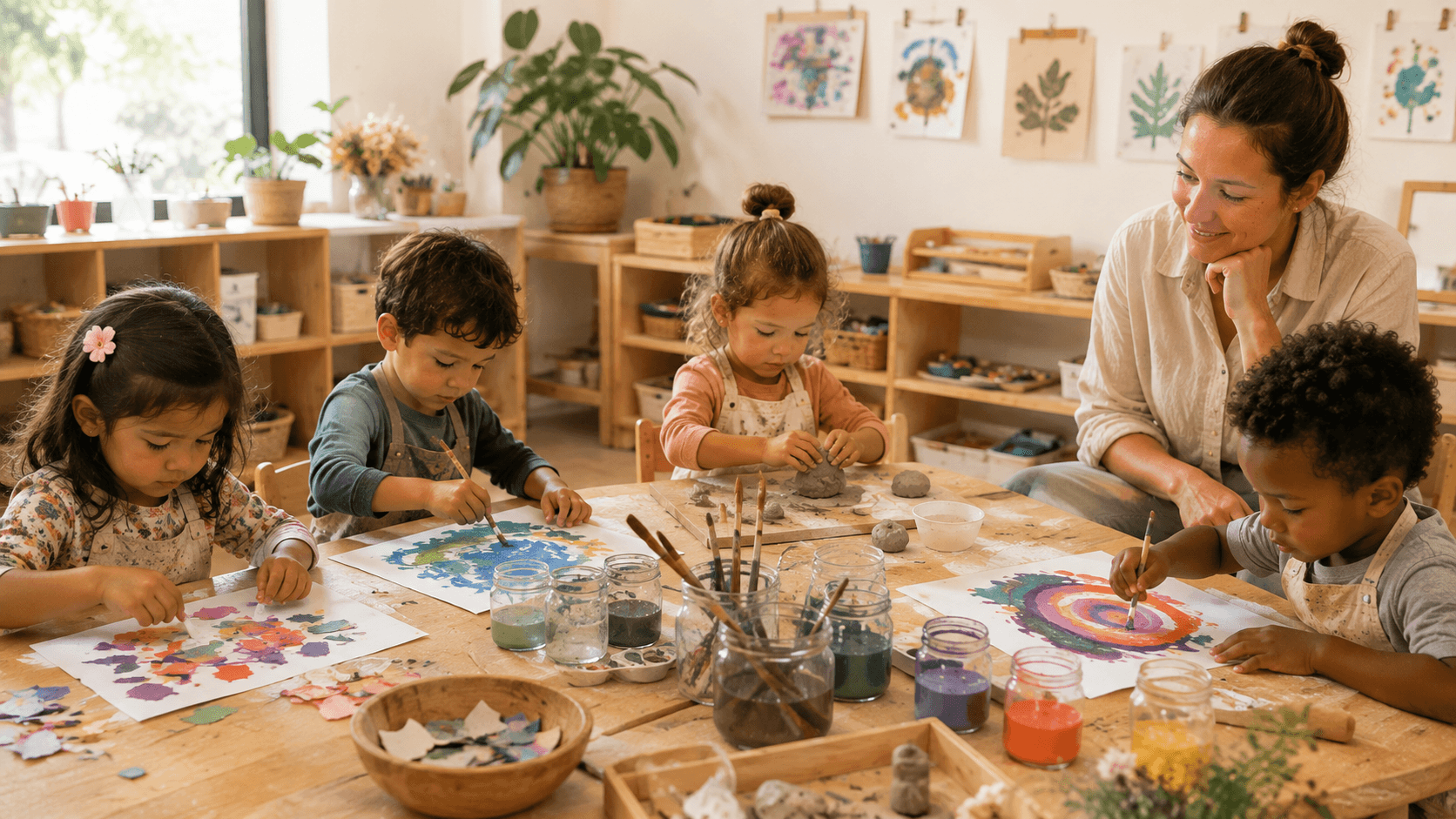
When many adults think about art, they picture a finished craft with matching steps, matching colors, and a result that looks the same for every child. In early childhood, however, some of the most meaningful art experiences look very different. Process art focuses on exploration, curiosity, and creative decision-making rather than copying a model or producing a “perfect” final piece.
In a process-focused activity, children are invited to explore materials in their own way. There is no single correct outcome, no pressure to match an example, and no expectation that every child’s work should look alike. That freedom matters because young children learn through doing, testing, noticing, and repeating.
Creative arts experiences in early childhood can support emotional expression, language development, sensory exploration, and flexible thinking. They also give children opportunities to build confidence as they make choices and discover what different tools and materials can do.
When many adults think about art, they picture a finished craft with matching steps, matching colors, and a result that looks the same for every child. In early childhood, however, some of the most meaningful art experiences look very different. Process art focuses on exploration, curiosity, and creative decision-making rather than copying a model or producing a “perfect” final piece.
In a process-focused activity, children are invited to explore materials in their own way. There is no single correct outcome, no pressure to match an example, and no expectation that every child’s work should look alike. That freedom matters because young children learn through doing, testing, noticing, and repeating.
Creative arts experiences in early childhood can support emotional expression, language development, sensory exploration, and flexible thinking. They also give children opportunities to build confidence as they make choices and discover what different tools and materials can do.
Good preschool art should look the same for every child.
In process art, differences are a strength. Each child explores materials, ideas, and decisions in their own way.
If it looks messy, it is probably not educational.
Open-ended art can support sensory exploration, fine motor practice, and problem-solving while children create.
Teachers should show exactly what the final project must look like.
Children often learn more when they are invited to experiment instead of copy a fixed model.
Art is only about making something cute to take home.
Creative experiences can also support confidence, communication, emotional expression, and flexible thinking.
Process art is especially valuable in early childhood because it allows children to participate at their own developmental level. One child may focus on color mixing, another may explore texture, and another may tell a story while creating. All of those experiences are meaningful because the learning is happening through the process itself.
Open-ended art can also strengthen fine motor development. Grasping brushes, squeezing glue, tearing paper, stamping shapes, rolling clay, and placing collage materials all help children practice coordination and control in natural, engaging ways. Just as importantly, these activities invite children to plan, adapt, and solve little problems as they create.
Creative arts also support communication. Children often describe what they are making, explain their choices, respond to classmates, and connect art to their own experiences. In that way, art becomes more than a visual activity. It becomes a space for self-expression, language, and relationship-building.
Process art is especially valuable in early childhood because it allows children to participate at their own developmental level. One child may focus on color mixing, another may explore texture, and another may tell a story while creating. All of those experiences are meaningful because the learning is happening through the process itself.
Open-ended art can also strengthen fine motor development. Grasping brushes, squeezing glue, tearing paper, stamping shapes, rolling clay, and placing collage materials all help children practice coordination and control in natural, engaging ways. Just as importantly, these activities invite children to plan, adapt, and solve little problems as they create.
Creative arts also support communication. Children often describe what they are making, explain their choices, respond to classmates, and connect art to their own experiences. In that way, art becomes more than a visual activity. It becomes a space for self-expression, language, and relationship-building.
Process art is especially valuable in early childhood because it allows children to participate at their own developmental level. One child may focus on color mixing, another may explore texture, and another may tell a story while creating. All of those experiences are meaningful because the learning is happening through the process itself.
Open-ended art can also strengthen fine motor development. Grasping brushes, squeezing glue, tearing paper, stamping shapes, rolling clay, and placing collage materials all help children practice coordination and control in natural, engaging ways. Just as importantly, these activities invite children to plan, adapt, and solve little problems as they create.
Creative arts also support communication. Children often describe what they are making, explain their choices, respond to classmates, and connect art to their own experiences. In that way, art becomes more than a visual activity. It becomes a space for self-expression, language, and relationship-building.
Each layer covers a different kind of risk, and together they create a much stronger safety net than any one step alone. A locked gate doesn't remove the need for supervision, and swim lessons don't remove the need for a life jacket on a boat.
The AAP recommends staying within arm's reach of young children in or near any water, including bathtubs and small pools. Assign one adult as the dedicated 'water watcher' with no phones or distractions.
Four-sided pool fencing with a self-latching gate can prevent more than half of all swimming pool drownings among young children by removing unsupervised access during non-swim times.
Formal swim lessons can begin after a child's first birthday. Skills alone don't prevent drowning, but they add an important layer alongside supervision and barriers.
Coast Guard-approved life jackets are far more reliable than inflatable arm floaties or toys, especially around boats, lakes, and open water where conditions change quickly.
Keeping a phone poolside and having at least one caregiver trained in CPR can make a critical difference in the rare moments when the other layers aren't enough.
Painting encourages experimentation with color, movement, and mark-making while helping children explore cause and effect.
Rolling, pressing, pinching, and shaping help strengthen little hands while supporting sensory play and imagination.
Paper scraps, fabric, tissue, and recycled pieces invite children to sort, layer, combine, and make creative choices.
Leaves, flowers, sticks, and textured objects help children connect art with observation and outdoor discovery.
Drawing tools support early control, visual expression, and storytelling as children represent ideas on paper.
These tools encourage coordination, sequencing, and experimentation as children test how different materials work together.
Each layer covers a different kind of risk, and together they create a much stronger safety net than any one step alone. A locked gate doesn't remove the need for supervision, and swim lessons don't remove the need for a life jacket on a boat.
The AAP recommends staying within arm's reach of young children in or near any water, including bathtubs and small pools. Assign one adult as the dedicated 'water watcher' with no phones or distractions.
Four-sided pool fencing with a self-latching gate can prevent more than half of all swimming pool drownings among young children by removing unsupervised access during non-swim times.
Formal swim lessons can begin after a child's first birthday. Skills alone don't prevent drowning, but they add an important layer alongside supervision and barriers.
Coast Guard-approved life jackets are far more reliable than inflatable arm floaties or toys, especially around boats, lakes, and open water where conditions change quickly.
Keeping a phone poolside and having at least one caregiver trained in CPR can make a critical difference in the rare moments when the other layers aren't enough.
When many adults think about art, they picture a finished craft with matching steps, matching colors, and a result that looks the same for every child. In early childhood, however, some of the most meaningful art experiences look very different. Process art focuses on exploration, curiosity, and creative decision-making rather than copying a model or producing a “perfect” final piece.
In a process-focused activity, children are invited to explore materials in their own way. There is no single correct outcome, no pressure to match an example, and no expectation that every child’s work should look alike. That freedom matters because young children learn through doing, testing, noticing, and repeating.
Creative arts experiences in early childhood can support emotional expression, language development, sensory exploration, and flexible thinking. They also give children opportunities to build confidence as they make choices and discover what different tools and materials can do.
In a daycare or preschool setting, process art often looks joyful, active, and slightly messy. Children may paint with unexpected tools, create collages from mixed materials, experiment with clay, or explore nature-based art using leaves, sticks, and textured objects. The goal is not to direct every step. The goal is to prepare a thoughtful environment where children can explore with guidance and support.
Families can support this kind of creativity at home too. That does not require expensive supplies or elaborate setups. A few simple materials like paper, crayons, tape, recycled items, child-safe paint, and playdough can open the door to meaningful creative time. What matters most is offering room for imagination instead of focusing too quickly on the finished result.
At Little Einsteins Academy of Tampa, creative experiences can help children build confidence, curiosity, and independence while also enjoying the simple pleasure of making something their own. When children feel safe to explore, creative arts become another way to learn, connect, and grow.
In a daycare or preschool setting, process art often looks joyful, active, and slightly messy. Children may paint with unexpected tools, create collages from mixed materials, experiment with clay, or explore nature-based art using leaves, sticks, and textured objects. The goal is not to direct every step. The goal is to prepare a thoughtful environment where children can explore with guidance and support.
Families can support this kind of creativity at home too. That does not require expensive supplies or elaborate setups. A few simple materials like paper, crayons, tape, recycled items, child-safe paint, and playdough can open the door to meaningful creative time. What matters most is offering room for imagination instead of focusing too quickly on the finished result.
At Little Einsteins Academy of Tampa, creative experiences can help children build confidence, curiosity, and independence while also enjoying the simple pleasure of making something their own. When children feel safe to explore, creative arts become another way to learn, connect, and grow.
In a daycare or preschool setting, process art often looks joyful, active, and slightly messy. Children may paint with unexpected tools, create collages from mixed materials, experiment with clay, or explore nature-based art using leaves, sticks, and textured objects. The goal is not to direct every step. The goal is to prepare a thoughtful environment where children can explore with guidance and support.
Families can support this kind of creativity at home too. That does not require expensive supplies or elaborate setups. A few simple materials like paper, crayons, tape, recycled items, child-safe paint, and playdough can open the door to meaningful creative time. What matters most is offering room for imagination instead of focusing too quickly on the finished result.
At Little Einsteins Academy of Tampa, creative experiences can help children build confidence, curiosity, and independence while also enjoying the simple pleasure of making something their own. When children feel safe to explore, creative arts become another way to learn, connect, and grow.
Process art is open-ended, but it is still intentional. Teachers prepare materials, create a supportive environment, and guide children as they explore, experiment, and express ideas.
Process art reminds us that creativity in early childhood is not about perfection. It is about experimentation, expression, and discovery. When children are given open-ended opportunities to create, they are not only making art. They are practicing how to think, choose, communicate, and trust their own ideas.
That is one reason creative arts remain such an important part of a balanced early learning experience. Through supportive, age-appropriate art opportunities, children can explore materials, build developmental skills, and experience the joy of creating in a way that feels personal and meaningful.
If you are looking for a daycare in Tampa that values creativity, hands-on learning, and child-centered exploration, Little Einsteins Academy of Tampa offers a nurturing environment where young learners can grow through everyday discovery.
Process art reminds us that creativity in early childhood is not about perfection. It is about experimentation, expression, and discovery. When children are given open-ended opportunities to create, they are not only making art. They are practicing how to think, choose, communicate, and trust their own ideas.
That is one reason creative arts remain such an important part of a balanced early learning experience. Through supportive, age-appropriate art opportunities, children can explore materials, build developmental skills, and experience the joy of creating in a way that feels personal and meaningful.
If you are looking for a daycare in Tampa that values creativity, hands-on learning, and child-centered exploration, Little Einsteins Academy of Tampa offers a nurturing environment where young learners can grow through everyday discovery.
Process art reminds us that creativity in early childhood is not about perfection. It is about experimentation, expression, and discovery. When children are given open-ended opportunities to create, they are not only making art. They are practicing how to think, choose, communicate, and trust their own ideas.
That is one reason creative arts remain such an important part of a balanced early learning experience. Through supportive, age-appropriate art opportunities, children can explore materials, build developmental skills, and experience the joy of creating in a way that feels personal and meaningful.
If you are looking for a daycare in Tampa that values creativity, hands-on learning, and child-centered exploration, Little Einsteins Academy of Tampa offers a nurturing environment where young learners can grow through everyday discovery.
At Little Einsteins Academy of Tampa, children can explore creative materials, express their ideas, and enjoy hands-on learning experiences that support confidence, curiosity, and development throughout the early years.
Talk with our team, learn more about our approach to hands-on learning, and see how Little Einsteins Academy of Tampa supports children through creativity, exploration, and nurturing daily care.
Disclaimer: This content is for general educational purposes only and is not a substitute for individual educational, developmental, or medical guidance. Children grow and express themselves in different ways. Little Einsteins Academy of Tampa operates under Florida DCF licensing requirements.
Categorías
Publicación reciente