Touch supervision, every time
The AAP recommends staying within arm's reach of young children in or near any water, including bathtubs and small pools. Assign one adult as the dedicated 'water watcher' with no phones or distractions.


Early Learning
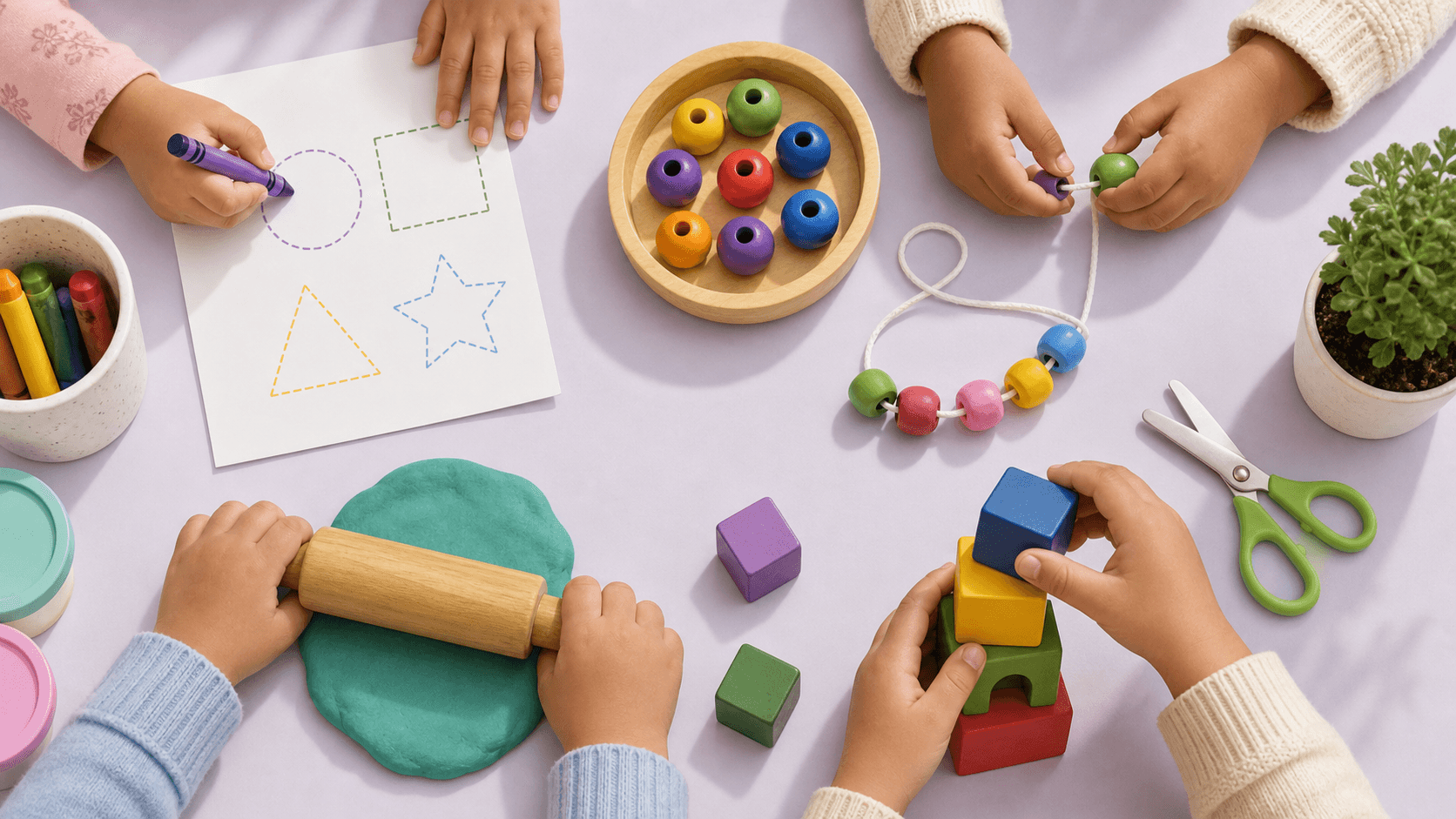
Fine motor skills are the small hand and finger movements children use for everyday tasks such as drawing, turning pages, buttoning clothing, using utensils, and holding classroom tools. These skills may seem simple, but they are part of the foundation for independence and early school participation. As children move through the preschool years, they gradually develop better coordination, stronger hand muscles, and more control over how they grasp and use objects.
School readiness is not only about letters and numbers. Children also need physical skills that help them manage materials, participate in activities, and feel capable during the school day. Fine motor development supports tasks like using crayons, trying scissors, manipulating puzzles, handling small objects, and taking care of simple self-help routines. Play-based fine motor activities such as beading, molding clay, using tweezers, and building with blocks are also linked to stronger prewriting and early classroom skills.
Parents often notice fine motor growth in ordinary moments rather than formal lessons. A child who starts opening containers more easily, drawing with more control, or using both hands together during play is building the same kind of coordination that supports school readiness later on. That is why fine motor practice works best when it is woven into everyday play, routines, and hands-on learning.
Fine motor skills are the small hand and finger movements children use for everyday tasks such as drawing, turning pages, buttoning clothing, using utensils, and holding classroom tools. These skills may seem simple, but they are part of the foundation for independence and early school participation. As children move through the preschool years, they gradually develop better coordination, stronger hand muscles, and more control over how they grasp and use objects.
School readiness is not only about letters and numbers. Children also need physical skills that help them manage materials, participate in activities, and feel capable during the school day. Fine motor development supports tasks like using crayons, trying scissors, manipulating puzzles, handling small objects, and taking care of simple self-help routines. Play-based fine motor activities such as beading, molding clay, using tweezers, and building with blocks are also linked to stronger prewriting and early classroom skills.
Parents often notice fine motor growth in ordinary moments rather than formal lessons. A child who starts opening containers more easily, drawing with more control, or using both hands together during play is building the same kind of coordination that supports school readiness later on. That is why fine motor practice works best when it is woven into everyday play, routines, and hands-on learning.
Children build hand strength, coordination, and control step by step through art, play, routines, and everyday classroom experiences.
One of the most effective ways to build fine motor skills is through playful repetition. Activities like playdough, threading, stacking, coloring, pegboards, and using child-safe tools help children strengthen their fingers and practice hand-eye coordination. These experiences are especially helpful because they feel engaging and age-appropriate rather than overly academic.
At daycare, fine motor development often happens across the whole day. Art centers, sensory bins, puzzles, building materials, and self-help routines all give children chances to use their hands with more purpose and control. Even small responsibilities like opening snack containers, cleaning up materials, or helping with simple classroom jobs can support independence and coordination. CDC guidance for preschool-age children also encourages activities that build independence through play and simple responsibilities.
Families can support the same growth at home without needing special equipment. Crayons, stickers, playdough, tongs, paper tearing, stringing large beads, simple crafts, and supervised scissor practice all offer valuable hand-strengthening opportunities. The goal is not perfection. The goal is steady progress, confidence, and more comfort using hands and fingers in meaningful ways.
One of the most effective ways to build fine motor skills is through playful repetition. Activities like playdough, threading, stacking, coloring, pegboards, and using child-safe tools help children strengthen their fingers and practice hand-eye coordination. These experiences are especially helpful because they feel engaging and age-appropriate rather than overly academic.
At daycare, fine motor development often happens across the whole day. Art centers, sensory bins, puzzles, building materials, and self-help routines all give children chances to use their hands with more purpose and control. Even small responsibilities like opening snack containers, cleaning up materials, or helping with simple classroom jobs can support independence and coordination. CDC guidance for preschool-age children also encourages activities that build independence through play and simple responsibilities.
Families can support the same growth at home without needing special equipment. Crayons, stickers, playdough, tongs, paper tearing, stringing large beads, simple crafts, and supervised scissor practice all offer valuable hand-strengthening opportunities. The goal is not perfection. The goal is steady progress, confidence, and more comfort using hands and fingers in meaningful ways.
One of the most effective ways to build fine motor skills is through playful repetition. Activities like playdough, threading, stacking, coloring, pegboards, and using child-safe tools help children strengthen their fingers and practice hand-eye coordination. These experiences are especially helpful because they feel engaging and age-appropriate rather than overly academic.
At daycare, fine motor development often happens across the whole day. Art centers, sensory bins, puzzles, building materials, and self-help routines all give children chances to use their hands with more purpose and control. Even small responsibilities like opening snack containers, cleaning up materials, or helping with simple classroom jobs can support independence and coordination. CDC guidance for preschool-age children also encourages activities that build independence through play and simple responsibilities.
Families can support the same growth at home without needing special equipment. Crayons, stickers, playdough, tongs, paper tearing, stringing large beads, simple crafts, and supervised scissor practice all offer valuable hand-strengthening opportunities. The goal is not perfection. The goal is steady progress, confidence, and more comfort using hands and fingers in meaningful ways.
Each layer covers a different kind of risk, and together they create a much stronger safety net than any one step alone. A locked gate doesn't remove the need for supervision, and swim lessons don't remove the need for a life jacket on a boat.
The AAP recommends staying within arm's reach of young children in or near any water, including bathtubs and small pools. Assign one adult as the dedicated 'water watcher' with no phones or distractions.
Four-sided pool fencing with a self-latching gate can prevent more than half of all swimming pool drownings among young children by removing unsupervised access during non-swim times.
Formal swim lessons can begin after a child's first birthday. Skills alone don't prevent drowning, but they add an important layer alongside supervision and barriers.
Coast Guard-approved life jackets are far more reliable than inflatable arm floaties or toys, especially around boats, lakes, and open water where conditions change quickly.
Keeping a phone poolside and having at least one caregiver trained in CPR can make a critical difference in the rare moments when the other layers aren't enough.
Puzzles, pegboards, stacking toys, and threading activities help children practice control, coordination, and patience.
Crayons, stickers, paintbrushes, tongs, and child-safe scissors strengthen the small muscles needed for classroom tasks.
Squeezing, rolling, pinching, and molding materials build hand strength in playful and low-pressure ways.
Opening containers, using utensils, dressing, and helping with simple cleanup all support fine motor growth.
Each layer covers a different kind of risk, and together they create a much stronger safety net than any one step alone. A locked gate doesn't remove the need for supervision, and swim lessons don't remove the need for a life jacket on a boat.
The AAP recommends staying within arm's reach of young children in or near any water, including bathtubs and small pools. Assign one adult as the dedicated 'water watcher' with no phones or distractions.
Four-sided pool fencing with a self-latching gate can prevent more than half of all swimming pool drownings among young children by removing unsupervised access during non-swim times.
Formal swim lessons can begin after a child's first birthday. Skills alone don't prevent drowning, but they add an important layer alongside supervision and barriers.
Coast Guard-approved life jackets are far more reliable than inflatable arm floaties or toys, especially around boats, lakes, and open water where conditions change quickly.
Keeping a phone poolside and having at least one caregiver trained in CPR can make a critical difference in the rare moments when the other layers aren't enough.
Fine motor skills are the small hand and finger movements children use for everyday tasks such as drawing, turning pages, buttoning clothing, using utensils, and holding classroom tools. These skills may seem simple, but they are part of the foundation for independence and early school participation. As children move through the preschool years, they gradually develop better coordination, stronger hand muscles, and more control over how they grasp and use objects.
School readiness is not only about letters and numbers. Children also need physical skills that help them manage materials, participate in activities, and feel capable during the school day. Fine motor development supports tasks like using crayons, trying scissors, manipulating puzzles, handling small objects, and taking care of simple self-help routines. Play-based fine motor activities such as beading, molding clay, using tweezers, and building with blocks are also linked to stronger prewriting and early classroom skills.
Parents often notice fine motor growth in ordinary moments rather than formal lessons. A child who starts opening containers more easily, drawing with more control, or using both hands together during play is building the same kind of coordination that supports school readiness later on. That is why fine motor practice works best when it is woven into everyday play, routines, and hands-on learning.
Parents often wonder whether a child needs a perfect pencil grip or advanced writing skills before starting school. In most cases, that is not the right way to think about readiness. Fine motor development is a gradual process, and children build these abilities over time through many different kinds of play, routines, and classroom experiences.
It is more helpful to look at the overall pattern of growth. For example, preschoolers may show progress by drawing more intentionally, using utensils more confidently, handling simple tools with support, or coordinating both hands together during tasks. CDC milestone guidance for ages 3 and 4 highlights growing independence, more complex play, and increasing ability to participate in tasks that depend on coordination and control.
If parents notice that a child consistently avoids using their hands, seems unusually frustrated by simple fine motor tasks, or is not making progress over time, it can be helpful to talk with teachers and a pediatrician. A short-term struggle with one task may be typical, but a larger pattern across settings can be worth discussing.
Parents often wonder whether a child needs a perfect pencil grip or advanced writing skills before starting school. In most cases, that is not the right way to think about readiness. Fine motor development is a gradual process, and children build these abilities over time through many different kinds of play, routines, and classroom experiences.
It is more helpful to look at the overall pattern of growth. For example, preschoolers may show progress by drawing more intentionally, using utensils more confidently, handling simple tools with support, or coordinating both hands together during tasks. CDC milestone guidance for ages 3 and 4 highlights growing independence, more complex play, and increasing ability to participate in tasks that depend on coordination and control.
If parents notice that a child consistently avoids using their hands, seems unusually frustrated by simple fine motor tasks, or is not making progress over time, it can be helpful to talk with teachers and a pediatrician. A short-term struggle with one task may be typical, but a larger pattern across settings can be worth discussing.
Parents often wonder whether a child needs a perfect pencil grip or advanced writing skills before starting school. In most cases, that is not the right way to think about readiness. Fine motor development is a gradual process, and children build these abilities over time through many different kinds of play, routines, and classroom experiences.
It is more helpful to look at the overall pattern of growth. For example, preschoolers may show progress by drawing more intentionally, using utensils more confidently, handling simple tools with support, or coordinating both hands together during tasks. CDC milestone guidance for ages 3 and 4 highlights growing independence, more complex play, and increasing ability to participate in tasks that depend on coordination and control.
If parents notice that a child consistently avoids using their hands, seems unusually frustrated by simple fine motor tasks, or is not making progress over time, it can be helpful to talk with teachers and a pediatrician. A short-term struggle with one task may be typical, but a larger pattern across settings can be worth discussing.
They help children manage classroom tools, art materials, self-help routines, and early writing-related tasks with more confidence and control.
A strong early learning environment helps children build school readiness through real experiences, not pressure. When children have daily opportunities to create, manipulate materials, practice routines, and gain independence, they build the physical confidence that supports learning across the preschool years.
At Little Einsteins Academy of Tampa, families can explore programs that support whole-child growth through hands-on learning, age-appropriate routines, and nurturing teacher guidance. From early classroom experiences to preschool and VPK preparation, children benefit from environments where confidence, coordination, and independence are built one small step at a time.
A strong early learning environment helps children build school readiness through real experiences, not pressure. When children have daily opportunities to create, manipulate materials, practice routines, and gain independence, they build the physical confidence that supports learning across the preschool years.
At Little Einsteins Academy of Tampa, families can explore programs that support whole-child growth through hands-on learning, age-appropriate routines, and nurturing teacher guidance. From early classroom experiences to preschool and VPK preparation, children benefit from environments where confidence, coordination, and independence are built one small step at a time.
A strong early learning environment helps children build school readiness through real experiences, not pressure. When children have daily opportunities to create, manipulate materials, practice routines, and gain independence, they build the physical confidence that supports learning across the preschool years.
At Little Einsteins Academy of Tampa, families can explore programs that support whole-child growth through hands-on learning, age-appropriate routines, and nurturing teacher guidance. From early classroom experiences to preschool and VPK preparation, children benefit from environments where confidence, coordination, and independence are built one small step at a time.
At Little Einsteins Academy of Tampa, children build confidence through guided play, classroom routines, and age-appropriate activities that support independence, coordination, and early learning.
Explore our programs, meet our team, and see how LEAO supports early learning through safe routines, caring relationships, and hands-on experiences for growing children.
Disclaimer: This content is for general educational purposes only and is not medical, developmental, or legal advice. Children develop at different rates. If you have concerns about your child’s development, speak with your pediatrician or a qualified specialist. Little Einsteins Academy of Tampa operates under Florida DCF licensing requirements.
Categories
Recent post


