Touch supervision, every time
The AAP recommends staying within arm's reach of young children in or near any water, including bathtubs and small pools. Assign one adult as the dedicated 'water watcher' with no phones or distractions.


Parenting Tips
Screens are everywhere — and so is the guilt that comes with them.
Most parents of young children have experienced the moment: you hand over a phone or tablet to get five minutes of peace, or to survive a restaurant meal, or because the day was just too long. And then comes the quiet voice asking whether you're damaging your child.
The research on screen time and early childhood is real, nuanced, and frequently misrepresented in parenting media. This guide cuts through the noise and tells you what the science actually says — what's harmful, what isn't, what the guidelines recommend, and how to think about screens in a way that's practical for real families.
The two most widely referenced guidelines come from the American Academy of Pediatrics (AAP) and the World Health Organization (WHO). Both were updated in 2023 and are broadly aligned.
Under 18 months: No screen use recommended, except video calling with family members. The exception for video calling reflects the interactive, social nature of that medium — it is categorically different from passive viewing.
18 to 24 months: If parents choose to introduce screens, high-quality programming only, watched together with a caregiver who talks about what's on screen. Solo passive viewing is not recommended.
2 to 5 years: Up to one hour per day of high-quality programming, co-viewed when possible. Quality matters enormously — not all content is equivalent.
6 years and older: Consistent limits on time and type of content, with screens not replacing sleep, physical activity, homework, or social interaction.
These are guidelines, not laws. Real families live in real circumstances. But understanding what the research supports helps parents make intentional choices rather than defaulting to whatever's convenient.
The impact of screen time is not uniform across all ages. The developing brain responds differently to screen exposure at different stages — which is why the guidelines change with age.
Screens are everywhere — and so is the guilt that comes with them.
Most parents of young children have experienced the moment: you hand over a phone or tablet to get five minutes of peace, or to survive a restaurant meal, or because the day was just too long. And then comes the quiet voice asking whether you're damaging your child.
The research on screen time and early childhood is real, nuanced, and frequently misrepresented in parenting media. This guide cuts through the noise and tells you what the science actually says — what's harmful, what isn't, what the guidelines recommend, and how to think about screens in a way that's practical for real families.
The two most widely referenced guidelines come from the American Academy of Pediatrics (AAP) and the World Health Organization (WHO). Both were updated in 2023 and are broadly aligned.
Under 18 months: No screen use recommended, except video calling with family members. The exception for video calling reflects the interactive, social nature of that medium — it is categorically different from passive viewing.
18 to 24 months: If parents choose to introduce screens, high-quality programming only, watched together with a caregiver who talks about what's on screen. Solo passive viewing is not recommended.
2 to 5 years: Up to one hour per day of high-quality programming, co-viewed when possible. Quality matters enormously — not all content is equivalent.
6 years and older: Consistent limits on time and type of content, with screens not replacing sleep, physical activity, homework, or social interaction.
These are guidelines, not laws. Real families live in real circumstances. But understanding what the research supports helps parents make intentional choices rather than defaulting to whatever's convenient.
The impact of screen time is not uniform across all ages. The developing brain responds differently to screen exposure at different stages — which is why the guidelines change with age.
One of the most important things the research shows — and that gets lost in the simple "limit screen time" message — is that content quality matters as much as quantity.
A 4-year-old watching an episode of a well-designed educational program co-viewed with a caregiver who asks questions and extends the content is having a meaningfully different experience than the same child passively watching a YouTube compilation for 45 minutes.
High-quality content for young children typically features:
Slow pacing — rapid cuts and fast-moving visuals are harder for young brains to process and learn from. Slower-paced programming gives children time to think.
Real language, not baby talk — programming that models rich vocabulary and complete sentences contributes more to language development than content simplified to the point of being linguistically thin.
Interaction prompts — content that pauses and asks children to respond (even if no one is actually listening) activates more cognitive engagement than purely passive content.
No advertising — commercial content embeds persuasion alongside entertainment in ways young children cannot cognitively distinguish. Ad-free programming is a meaningful quality marker.
These are evidence-informed approaches that work in real family life — not idealized scenarios where screens don't exist.
One of the most important things the research shows — and that gets lost in the simple "limit screen time" message — is that content quality matters as much as quantity.
A 4-year-old watching an episode of a well-designed educational program co-viewed with a caregiver who asks questions and extends the content is having a meaningfully different experience than the same child passively watching a YouTube compilation for 45 minutes.
High-quality content for young children typically features:
Slow pacing — rapid cuts and fast-moving visuals are harder for young brains to process and learn from. Slower-paced programming gives children time to think.
Real language, not baby talk — programming that models rich vocabulary and complete sentences contributes more to language development than content simplified to the point of being linguistically thin.
Interaction prompts — content that pauses and asks children to respond (even if no one is actually listening) activates more cognitive engagement than purely passive content.
No advertising — commercial content embeds persuasion alongside entertainment in ways young children cannot cognitively distinguish. Ad-free programming is a meaningful quality marker.
These are evidence-informed approaches that work in real family life — not idealized scenarios where screens don't exist.
One of the most important things the research shows — and that gets lost in the simple "limit screen time" message — is that content quality matters as much as quantity.
A 4-year-old watching an episode of a well-designed educational program co-viewed with a caregiver who asks questions and extends the content is having a meaningfully different experience than the same child passively watching a YouTube compilation for 45 minutes.
High-quality content for young children typically features:
Slow pacing — rapid cuts and fast-moving visuals are harder for young brains to process and learn from. Slower-paced programming gives children time to think.
Real language, not baby talk — programming that models rich vocabulary and complete sentences contributes more to language development than content simplified to the point of being linguistically thin.
Interaction prompts — content that pauses and asks children to respond (even if no one is actually listening) activates more cognitive engagement than purely passive content.
No advertising — commercial content embeds persuasion alongside entertainment in ways young children cannot cognitively distinguish. Ad-free programming is a meaningful quality marker.
These are evidence-informed approaches that work in real family life — not idealized scenarios where screens don't exist.
Each layer covers a different kind of risk, and together they create a much stronger safety net than any one step alone. A locked gate doesn't remove the need for supervision, and swim lessons don't remove the need for a life jacket on a boat.
The AAP recommends staying within arm's reach of young children in or near any water, including bathtubs and small pools. Assign one adult as the dedicated 'water watcher' with no phones or distractions.
Four-sided pool fencing with a self-latching gate can prevent more than half of all swimming pool drownings among young children by removing unsupervised access during non-swim times.
Formal swim lessons can begin after a child's first birthday. Skills alone don't prevent drowning, but they add an important layer alongside supervision and barriers.
Coast Guard-approved life jackets are far more reliable than inflatable arm floaties or toys, especially around boats, lakes, and open water where conditions change quickly.
Keeping a phone poolside and having at least one caregiver trained in CPR can make a critical difference in the rare moments when the other layers aren't enough.
The infant brain learns through face-to-face interaction, physical exploration, and responsive human connection. Screens cannot replicate these — and passive viewing displaces the experiences that actually build early brain architecture.
What the research shows
Each layer covers a different kind of risk, and together they create a much stronger safety net than any one step alone. A locked gate doesn't remove the need for supervision, and swim lessons don't remove the need for a life jacket on a boat.
The AAP recommends staying within arm's reach of young children in or near any water, including bathtubs and small pools. Assign one adult as the dedicated 'water watcher' with no phones or distractions.
Four-sided pool fencing with a self-latching gate can prevent more than half of all swimming pool drownings among young children by removing unsupervised access during non-swim times.
Formal swim lessons can begin after a child's first birthday. Skills alone don't prevent drowning, but they add an important layer alongside supervision and barriers.
Coast Guard-approved life jackets are far more reliable than inflatable arm floaties or toys, especially around boats, lakes, and open water where conditions change quickly.
Keeping a phone poolside and having at least one caregiver trained in CPR can make a critical difference in the rare moments when the other layers aren't enough.
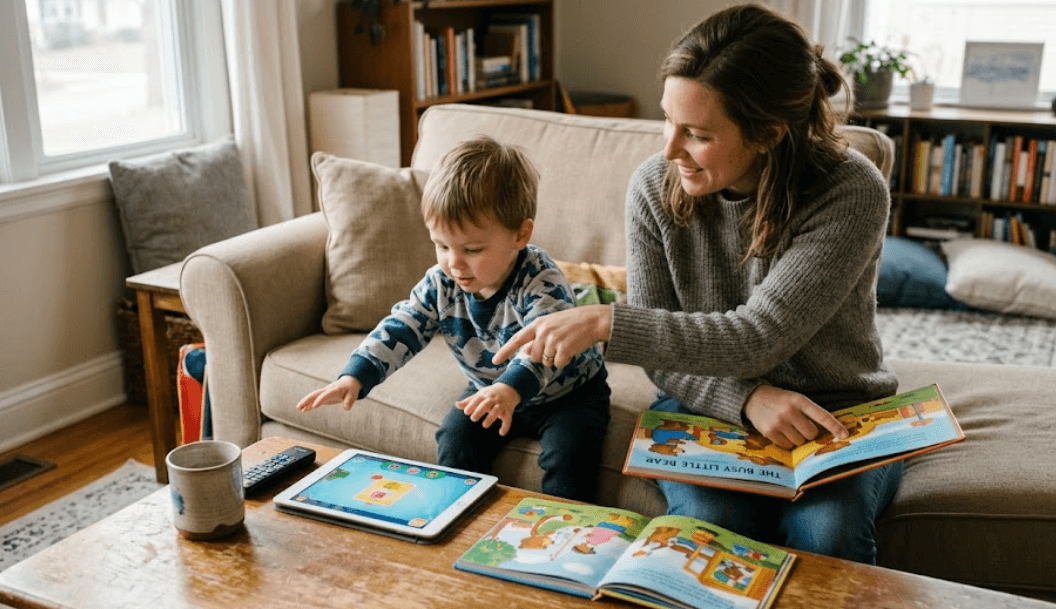
When your child watches something, watch it with them when possible. Ask questions, name what you see, connect it to real life. Co-viewing transforms passive consumption into an active learning experience.
Not all children's content is equivalent. Look for slow pacing, rich language, interactive prompts, and no advertising. A handful of high-quality shows watched repeatedly beats a rotating feed of low-quality content.
Bedroom screens consistently displace sleep across all age groups. The bedroom should be associated with rest — not entertainment. This boundary is one of the most evidence-supported screen time recommendations available.
"Five more minutes" followed by a consistent, calm transition dramatically reduces meltdowns. The dopamine drop when screens end is real — a warning gives the brain time to prepare for the shift.
Mealtime conversation is one of the richest language-learning opportunities in a child's day. Background TV at meals reduces conversation, slows language development, and displaces family connection. Screens off at the table is a high-value habit.
Blue light suppresses melatonin. Fast-moving content activates rather than calms the brain. The hour before bed should be screen-free — books, quiet play, bath, conversation. This single habit improves sleep onset significantly.
Children watch what adults do, not what adults say. If you're on your phone while your child plays, they're learning that screens are the default activity. Put your own device away during play time — even briefly. It matters.
The most useful question isn't "how many minutes?" but "what is screen time replacing today?" If it's replacing outdoor play, physical activity, reading, or human conversation — that's the concern. If it's replacing a third viewing of the same show, the calculus is different.
Screens are everywhere — and so is the guilt that comes with them.
Most parents of young children have experienced the moment: you hand over a phone or tablet to get five minutes of peace, or to survive a restaurant meal, or because the day was just too long. And then comes the quiet voice asking whether you're damaging your child.
The research on screen time and early childhood is real, nuanced, and frequently misrepresented in parenting media. This guide cuts through the noise and tells you what the science actually says — what's harmful, what isn't, what the guidelines recommend, and how to think about screens in a way that's practical for real families.
The two most widely referenced guidelines come from the American Academy of Pediatrics (AAP) and the World Health Organization (WHO). Both were updated in 2023 and are broadly aligned.
Under 18 months: No screen use recommended, except video calling with family members. The exception for video calling reflects the interactive, social nature of that medium — it is categorically different from passive viewing.
18 to 24 months: If parents choose to introduce screens, high-quality programming only, watched together with a caregiver who talks about what's on screen. Solo passive viewing is not recommended.
2 to 5 years: Up to one hour per day of high-quality programming, co-viewed when possible. Quality matters enormously — not all content is equivalent.
6 years and older: Consistent limits on time and type of content, with screens not replacing sleep, physical activity, homework, or social interaction.
These are guidelines, not laws. Real families live in real circumstances. But understanding what the research supports helps parents make intentional choices rather than defaulting to whatever's convenient.
The impact of screen time is not uniform across all ages. The developing brain responds differently to screen exposure at different stages — which is why the guidelines change with age.
At Little Einsteins Academy of Tampa, we build every classroom around the experiences that research shows actually develop young children — human connection, physical exploration, language-rich interaction, and play. Screens don't have a place in that picture, and they don't need one.
What every LEAO classroom offers instead
Come see what learning without screens looks like.
Schedule a tour and see how our classrooms keep children engaged, curious, and developing — with real experiences, not screens.
Screen time guidelines referenced from the American Academy of Pediatrics (2023) and World Health Organization (2023). For guidance specific to your child, consult your pediatrician. Little Einsteins Academy of Tampa is fully licensed by the Florida Department of Children and Families.
Categories
Recent post