Touch supervision, every time
The AAP recommends staying within arm's reach of young children in or near any water, including bathtubs and small pools. Assign one adult as the dedicated 'water watcher' with no phones or distractions.


Language & Literacy
Between ages 1 and 3, children go from saying a handful of words to producing sentences, asking questions, and telling simple stories. It's one of the most dramatic developmental leaps in human life — and parents play a more direct role in it than most realize.
Research on early language development is consistent: the single greatest predictor of a child's vocabulary size and language ability at school age is the quantity and quality of language they were exposed to in the first three years of life. Not apps. Not flashcards. Not educational videos. Conversation — real, back-and-forth, responsive conversation with the adults in their lives.
The good news is that you don't need a curriculum or a special program to support your toddler's language development. You need to know how to talk to them — and this guide will show you exactly that.
Understanding the sequence of language development helps parents know what to expect and what to support at each stage.
Birth to 6 months — babies communicate through crying, cooing, and facial expressions. They're already tuning into the rhythm and sound of language long before they produce words. Talk to your baby constantly — narrate what you're doing, describe what they're seeing, respond to their sounds as if they're words.
6 to 12 months — babbling begins. Babies experiment with consonant-vowel combinations ("ba ba," "da da") and start to understand that sounds carry meaning. They respond to their name, understand "no," and begin pointing. Point back. Name everything they point at.
12 to 18 months — first words emerge. Most children say between 1 and 20 words by 18 months. They understand far more than they say. "Jargon" — long strings of babble with real intonation — is common and normal.
18 to 24 months — vocabulary explosion. Many children add several new words per day during this window. Two-word combinations appear ("more milk," "daddy go"). This is when the gap between children with language-rich environments and those without becomes clearly visible.
24 to 36 months — sentences of 3 to 4 words, questions begin ("where daddy?"), and children start to tell simple stories. By age 3, most children can be understood by familiar adults most of the time.
These strategies are drawn from speech-language research and early childhood best practices. None of them require special materials — just intentional conversation.
Between ages 1 and 3, children go from saying a handful of words to producing sentences, asking questions, and telling simple stories. It's one of the most dramatic developmental leaps in human life — and parents play a more direct role in it than most realize.
Research on early language development is consistent: the single greatest predictor of a child's vocabulary size and language ability at school age is the quantity and quality of language they were exposed to in the first three years of life. Not apps. Not flashcards. Not educational videos. Conversation — real, back-and-forth, responsive conversation with the adults in their lives.
The good news is that you don't need a curriculum or a special program to support your toddler's language development. You need to know how to talk to them — and this guide will show you exactly that.
Understanding the sequence of language development helps parents know what to expect and what to support at each stage.
Birth to 6 months — babies communicate through crying, cooing, and facial expressions. They're already tuning into the rhythm and sound of language long before they produce words. Talk to your baby constantly — narrate what you're doing, describe what they're seeing, respond to their sounds as if they're words.
6 to 12 months — babbling begins. Babies experiment with consonant-vowel combinations ("ba ba," "da da") and start to understand that sounds carry meaning. They respond to their name, understand "no," and begin pointing. Point back. Name everything they point at.
12 to 18 months — first words emerge. Most children say between 1 and 20 words by 18 months. They understand far more than they say. "Jargon" — long strings of babble with real intonation — is common and normal.
18 to 24 months — vocabulary explosion. Many children add several new words per day during this window. Two-word combinations appear ("more milk," "daddy go"). This is when the gap between children with language-rich environments and those without becomes clearly visible.
24 to 36 months — sentences of 3 to 4 words, questions begin ("where daddy?"), and children start to tell simple stories. By age 3, most children can be understood by familiar adults most of the time.
These strategies are drawn from speech-language research and early childhood best practices. None of them require special materials — just intentional conversation.
Children in high-quality daycare programs spend more waking hours in their care setting than at home during the week. That means the language environment inside a daycare classroom has a real and measurable impact on language development — for better or worse.
At Little Einsteins Academy of Tampa, language development is woven into every part of the day. Teachers are trained to use the same evidence-based strategies listed above — narrating activities, asking open-ended questions, expanding children's utterances, and reading aloud daily across all age groups.
The combination of a language-rich home environment and a language-rich daycare setting is the most powerful thing you can give a young child's developing brain.
Knowing what helps is only half the picture. These common habits — most well-intentioned — can unintentionally limit language development.
Children in high-quality daycare programs spend more waking hours in their care setting than at home during the week. That means the language environment inside a daycare classroom has a real and measurable impact on language development — for better or worse.
At Little Einsteins Academy of Tampa, language development is woven into every part of the day. Teachers are trained to use the same evidence-based strategies listed above — narrating activities, asking open-ended questions, expanding children's utterances, and reading aloud daily across all age groups.
The combination of a language-rich home environment and a language-rich daycare setting is the most powerful thing you can give a young child's developing brain.
Knowing what helps is only half the picture. These common habits — most well-intentioned — can unintentionally limit language development.
Children in high-quality daycare programs spend more waking hours in their care setting than at home during the week. That means the language environment inside a daycare classroom has a real and measurable impact on language development — for better or worse.
At Little Einsteins Academy of Tampa, language development is woven into every part of the day. Teachers are trained to use the same evidence-based strategies listed above — narrating activities, asking open-ended questions, expanding children's utterances, and reading aloud daily across all age groups.
The combination of a language-rich home environment and a language-rich daycare setting is the most powerful thing you can give a young child's developing brain.
Knowing what helps is only half the picture. These common habits — most well-intentioned — can unintentionally limit language development.
Each layer covers a different kind of risk, and together they create a much stronger safety net than any one step alone. A locked gate doesn't remove the need for supervision, and swim lessons don't remove the need for a life jacket on a boat.
The AAP recommends staying within arm's reach of young children in or near any water, including bathtubs and small pools. Assign one adult as the dedicated 'water watcher' with no phones or distractions.
Four-sided pool fencing with a self-latching gate can prevent more than half of all swimming pool drownings among young children by removing unsupervised access during non-swim times.
Formal swim lessons can begin after a child's first birthday. Skills alone don't prevent drowning, but they add an important layer alongside supervision and barriers.
Coast Guard-approved life jackets are far more reliable than inflatable arm floaties or toys, especially around boats, lakes, and open water where conditions change quickly.
Keeping a phone poolside and having at least one caregiver trained in CPR can make a critical difference in the rare moments when the other layers aren't enough.
Running commentary on your daily activities — "Now I'm washing the apple, it's cold and round and red" — exposes children to vocabulary in context. It feels strange at first. Do it anyway.
When your toddler says "dog," you say "Yes, the big brown dog is running fast!" You're taking their word and modeling a fuller sentence — without correcting or quizzing them.
"What do you see?" gets more language than "Do you see the dog?" Open questions invite children to produce language rather than just confirm or deny with a nod.
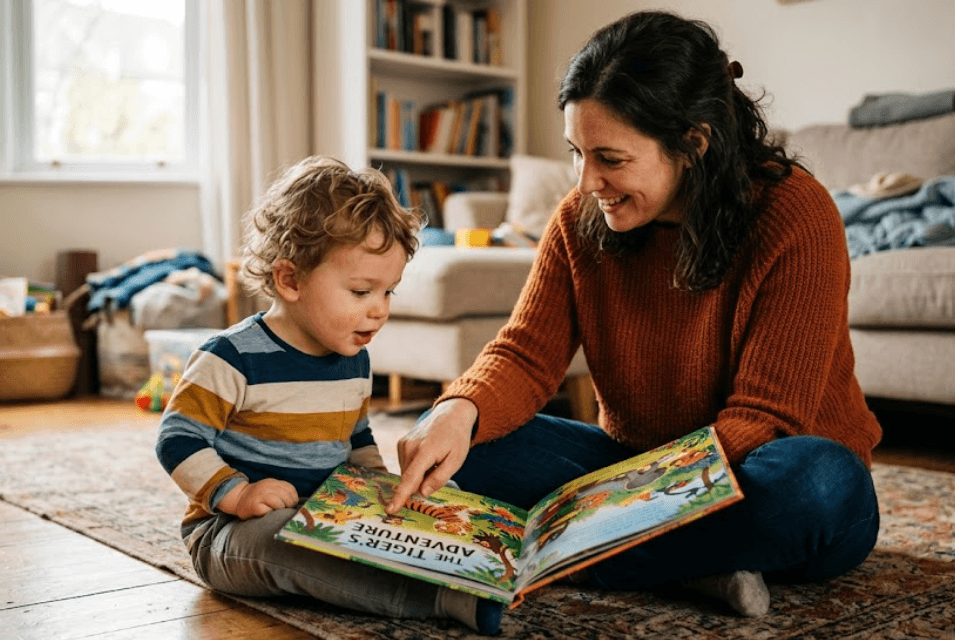
Reading isn't just about the words on the page. Point at pictures, ask "What's that?" and "What do you think happens next?" The conversation around the book builds as much language as the text itself.
Talk about whatever your child is paying attention to right now. Language sticks when it's attached to something the child already finds interesting. If they're fixated on a truck, talk about trucks.
Toddlers process language more slowly than adults. After asking a question or making a comment, wait — really wait, up to 10 seconds — before jumping in. The pause is where language production happens.
Songs and rhymes expose children to rhythm, repetition, and phonological patterns that directly support later reading. Nursery rhymes aren't just entertainment — they're pre-literacy training.
"You look frustrated. You really wanted that toy." Naming emotions builds emotional vocabulary — which is part of language development — and helps children learn to express feelings with words instead of behavior.
Each layer covers a different kind of risk, and together they create a much stronger safety net than any one step alone. A locked gate doesn't remove the need for supervision, and swim lessons don't remove the need for a life jacket on a boat.
The AAP recommends staying within arm's reach of young children in or near any water, including bathtubs and small pools. Assign one adult as the dedicated 'water watcher' with no phones or distractions.
Four-sided pool fencing with a self-latching gate can prevent more than half of all swimming pool drownings among young children by removing unsupervised access during non-swim times.
Formal swim lessons can begin after a child's first birthday. Skills alone don't prevent drowning, but they add an important layer alongside supervision and barriers.
Coast Guard-approved life jackets are far more reliable than inflatable arm floaties or toys, especially around boats, lakes, and open water where conditions change quickly.
Keeping a phone poolside and having at least one caregiver trained in CPR can make a critical difference in the rare moments when the other layers aren't enough.
TV or videos playing in the background — even when no one is actively watching — reduce the quantity of parent-child conversation. Background media competes for attention and consistently lowers the amount of language children hear.
"What color is that? What's this called? How many are there?" Back-to-back test questions feel like a quiz, not a conversation. Children disengage. Talk with them, not at them.
If you ask a question and then answer it yourself 2 seconds later, children learn they don't need to produce language — you'll do it for them. Wait. The silence is productive.
When a toddler says "wabbit" and you respond "No, say RABBIT," it introduces shame into the conversation. Instead, model the correct form naturally: "Yes! A rabbit! The rabbit is hopping." They'll self-correct over time.
Devices are powerful attention-holders — which is exactly why they displace conversation. Every time a child gets a phone or tablet to stay quiet, a window for language interaction closes. Reserve screens intentionally, not habitually.
Between ages 1 and 3, children go from saying a handful of words to producing sentences, asking questions, and telling simple stories. It's one of the most dramatic developmental leaps in human life — and parents play a more direct role in it than most realize.
Research on early language development is consistent: the single greatest predictor of a child's vocabulary size and language ability at school age is the quantity and quality of language they were exposed to in the first three years of life. Not apps. Not flashcards. Not educational videos. Conversation — real, back-and-forth, responsive conversation with the adults in their lives.
The good news is that you don't need a curriculum or a special program to support your toddler's language development. You need to know how to talk to them — and this guide will show you exactly that.
Understanding the sequence of language development helps parents know what to expect and what to support at each stage.
Birth to 6 months — babies communicate through crying, cooing, and facial expressions. They're already tuning into the rhythm and sound of language long before they produce words. Talk to your baby constantly — narrate what you're doing, describe what they're seeing, respond to their sounds as if they're words.
6 to 12 months — babbling begins. Babies experiment with consonant-vowel combinations ("ba ba," "da da") and start to understand that sounds carry meaning. They respond to their name, understand "no," and begin pointing. Point back. Name everything they point at.
12 to 18 months — first words emerge. Most children say between 1 and 20 words by 18 months. They understand far more than they say. "Jargon" — long strings of babble with real intonation — is common and normal.
18 to 24 months — vocabulary explosion. Many children add several new words per day during this window. Two-word combinations appear ("more milk," "daddy go"). This is when the gap between children with language-rich environments and those without becomes clearly visible.
24 to 36 months — sentences of 3 to 4 words, questions begin ("where daddy?"), and children start to tell simple stories. By age 3, most children can be understood by familiar adults most of the time.
These strategies are drawn from speech-language research and early childhood best practices. None of them require special materials — just intentional conversation.
At Little Einsteins Academy of Tampa, language development isn't a special program — it's built into every conversation, every storytime, every song, and every transition throughout the day. Your child is learning to communicate every moment they're with us.
What every LEAO classroom includes
Language is learned in conversation. Let's start one.
Come visit LEAO and see how our classrooms bring language to life every single day.
Language development milestones vary between children. If you have concerns about your child's language development, we encourage a conversation with your child's teacher and pediatrician. Florida's Early Steps program provides free evaluations for children under 3.
Categorías
Publicación reciente