Touch supervision, every time
The AAP recommends staying within arm's reach of young children in or near any water, including bathtubs and small pools. Assign one adult as the dedicated 'water watcher' with no phones or distractions.


Creative Arts
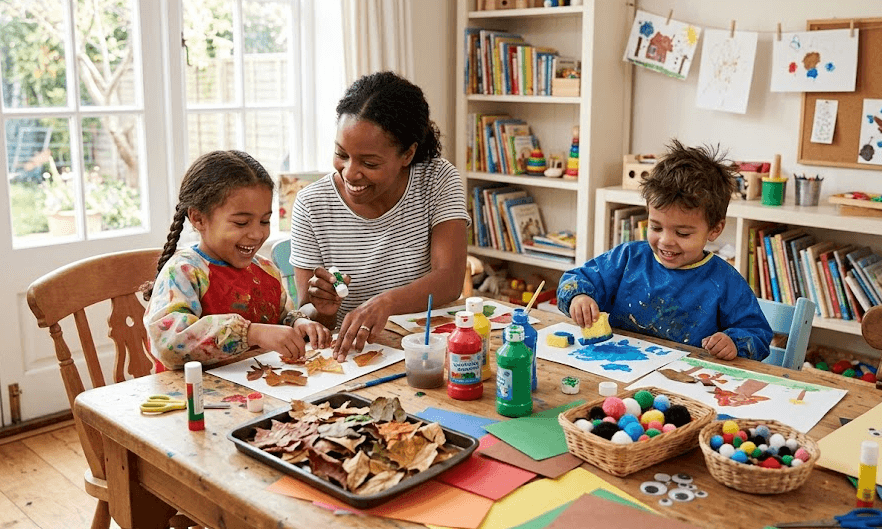
You don't need to be an artist to do art with your child. You don't need expensive supplies, a dedicated craft room, or a Pinterest-worthy setup. Some paint, some paper, a few things from your kitchen — and a willingness to let things get messy — is all it takes to give your child one of the most valuable developmental experiences there is.
Art isn't just about making something pretty. For young children, the process of creating — choosing colors, tearing paper, squishing paint between fingers, deciding what to draw — builds fine motor skills, strengthens problem-solving, develops self-expression, and nurtures the kind of creative thinking that carries into every area of learning. This guide gives you five simple, age-appropriate art projects you can do at home today — no art degree required.
When your child picks up a crayon or dips their fingers in paint, their brain is doing far more than making marks on paper:
You don't need to be an artist to do art with your child. You don't need expensive supplies, a dedicated craft room, or a Pinterest-worthy setup. Some paint, some paper, a few things from your kitchen — and a willingness to let things get messy — is all it takes to give your child one of the most valuable developmental experiences there is.
Art isn't just about making something pretty. For young children, the process of creating — choosing colors, tearing paper, squishing paint between fingers, deciding what to draw — builds fine motor skills, strengthens problem-solving, develops self-expression, and nurtures the kind of creative thinking that carries into every area of learning. This guide gives you five simple, age-appropriate art projects you can do at home today — no art degree required.
When your child picks up a crayon or dips their fingers in paint, their brain is doing far more than making marks on paper:
Each project is organized by the youngest age that can do it, but older children will enjoy them too. All use simple materials you probably already have.
Each project is organized by the youngest age that can do it, but older children will enjoy them too. All use simple materials you probably already have.
Each project is organized by the youngest age that can do it, but older children will enjoy them too. All use simple materials you probably already have.
Each layer covers a different kind of risk, and together they create a much stronger safety net than any one step alone. A locked gate doesn't remove the need for supervision, and swim lessons don't remove the need for a life jacket on a boat.
The AAP recommends staying within arm's reach of young children in or near any water, including bathtubs and small pools. Assign one adult as the dedicated 'water watcher' with no phones or distractions.
Four-sided pool fencing with a self-latching gate can prevent more than half of all swimming pool drownings among young children by removing unsupervised access during non-swim times.
Formal swim lessons can begin after a child's first birthday. Skills alone don't prevent drowning, but they add an important layer alongside supervision and barriers.
Coast Guard-approved life jackets are far more reliable than inflatable arm floaties or toys, especially around boats, lakes, and open water where conditions change quickly.
Keeping a phone poolside and having at least one caregiver trained in CPR can make a critical difference in the rare moments when the other layers aren't enough.
Each layer covers a different kind of risk, and together they create a much stronger safety net than any one step alone. A locked gate doesn't remove the need for supervision, and swim lessons don't remove the need for a life jacket on a boat.
The AAP recommends staying within arm's reach of young children in or near any water, including bathtubs and small pools. Assign one adult as the dedicated 'water watcher' with no phones or distractions.
Four-sided pool fencing with a self-latching gate can prevent more than half of all swimming pool drownings among young children by removing unsupervised access during non-swim times.
Formal swim lessons can begin after a child's first birthday. Skills alone don't prevent drowning, but they add an important layer alongside supervision and barriers.
Coast Guard-approved life jackets are far more reliable than inflatable arm floaties or toys, especially around boats, lakes, and open water where conditions change quickly.
Keeping a phone poolside and having at least one caregiver trained in CPR can make a critical difference in the rare moments when the other layers aren't enough.
The simplest art project there is — and one of the most developmentally powerful for babies and young toddlers.
Tearing paper is actually a significant fine motor skill for toddlers — and turning torn pieces into a collage makes it creative.
Combines outdoor exploration with art — perfect for Tampa's sunny weather and for burning energy before the creative part.
Simple, satisfying, and endlessly adaptable — gives toddlers and preschoolers a new way to make marks without needing a brush.
Perfect for preschoolers who are becoming more aware of themselves and others. Combines drawing, collage, and self-reflection.
You don't need to be an artist to do art with your child. You don't need expensive supplies, a dedicated craft room, or a Pinterest-worthy setup. Some paint, some paper, a few things from your kitchen — and a willingness to let things get messy — is all it takes to give your child one of the most valuable developmental experiences there is.
Art isn't just about making something pretty. For young children, the process of creating — choosing colors, tearing paper, squishing paint between fingers, deciding what to draw — builds fine motor skills, strengthens problem-solving, develops self-expression, and nurtures the kind of creative thinking that carries into every area of learning. This guide gives you five simple, age-appropriate art projects you can do at home today — no art degree required.
When your child picks up a crayon or dips their fingers in paint, their brain is doing far more than making marks on paper:
At Little Einsteins Academy of Tampa, art isn't an occasional activity — it's a daily practice. Here's how creativity lives in our classrooms:
At Little Einsteins Academy of Tampa, art isn't an occasional activity — it's a daily practice. Here's how creativity lives in our classrooms:
At Little Einsteins Academy of Tampa, art isn't an occasional activity — it's a daily practice. Here's how creativity lives in our classrooms:
Absolutely. Scribbling is the first stage of artistic development, and it's incredibly important. When your child scribbles, they're practicing hand control, exploring cause and effect, and expressing themselves. Don't dismiss scribbles — celebrate them.
Don't force it. Some children prefer building, music, or physical play. But you can invite creativity into those activities too — building with blocks is spatial art, dancing is movement art, making up songs is musical art. Keep art supplies accessible and let interest develop naturally.
As messy as you can tolerate. Mess is part of the creative process for young children. Set up a protected area, use washable materials, and let them explore freely. The more comfortable they are getting messy, the more they'll experiment and learn.
For children under 5, no. Let them develop their own visual language. Showing a child "how to draw a house" can actually limit their creativity by making them feel their version isn't correct. Provide materials and encouragement, and let their drawing skills develop naturally.
Keep it simple: thick crayons or chunky markers for toddlers, washable paint, construction paper, glue sticks, safety scissors (for preschoolers), playdough, and a variety of collage materials like fabric scraps, buttons, and natural objects. Quality doesn't matter — variety and accessibility do.
At Little Einsteins Academy of Tampa, every day includes time for art, exploration, and creative expression — from our infant rooms to VPK. Schedule a tour to see our creative spaces in action and discover how we help children develop confidence, imagination, and a love of making things.
Disclaimer: All art projects described in this article use non-toxic, child-safe materials. Always supervise young children during art activities, especially when using small items like buttons, beads, or natural objects that could pose a choking hazard. Adjust projects as needed based on your child's age and abilities.
Categories
Recent post